Trainer stats remain one of the most important tools in serious handicapping. They offer insight into intent, placement, and patterns that repeat across thousands of races.
This post is a practical walkthrough of:
-
Where to find trainer stats in the Daily Racing Form
-
How experienced handicappers read them correctly
-
How those stats fit into a complete race analysis, alongside every other major data point
Why Trainer Stats Matter
Trainer statistics are valuable because they reflect decision-making, not just raw performance.
Situations like:
-
Second start off a layoff
-
First start after a claim
-
Maiden Special Weight to Maiden Claiming
-
Surface or distance changes
These are not random moves. Over time, patterns emerge—and the DRF makes those patterns visible.
For experienced players, trainer stats are not a shortcut. They are one essential piece of the puzzle.
Where to Find Trainer Stats in the DRF
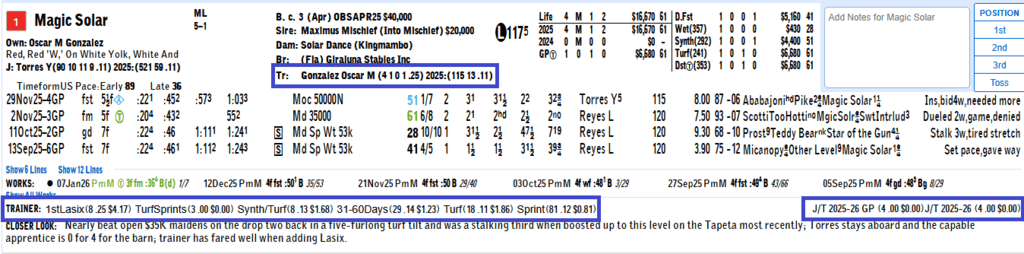
Key Areas to Review
Trainer / Jockey Box
-
Win percentage
-
Starts
-
ROI
-
Trainer–jockey combination performance
Situation-Based Trainer Stats
-
Second off the layoff
-
First start after a claim
-
MSW → MCL
-
First-time starters
-
Turf-to-dirt or dirt-to-turf moves
Surface and Distance Splits
-
How the trainer performs under today’s specific conditions
All of this information is already there. The value comes from knowing how to interpret it in context.
How to Read Trainer Stats Correctly
Experienced handicappers don’t treat trainer stats as standalone signals.
They’re evaluated alongside:
-
Today’s class level
-
Distance and surface suitability
-
The horse’s recent form
-
How the race is likely to be run
A trainer stat carries more meaning when it aligns with logical placement and race structure.
Trainer stats don’t decide races by themselves—but they often explain why a horse is in today’s spot.
Scaling Trainer Analysis Across an Entire Race
This is where the workload increases.
A single race can involve:
-
8–12+ horses
-
Multiple trainer categories per horse
-
Each one needing to be evaluated in context
Now expand that across an entire card.
Doing this properly takes time—and doing it consistently, race after race, is the real challenge.
How We Analyze an Entire Race
Trainer stats are just one of the many data points our AI processes for every race.
What the AI Evaluates Together
-
Trainer statistics for every horse
-
Pace dynamics
-
Speed and energy distribution
-
Class movement
-
Distance and surface compatibility
-
Track-specific tendencies
Nothing is isolated. Everything is evaluated as part of the race.
The focus isn’t on one stat—it’s on how all the data fits together.
Why Complete Analysis Matters
Races are won and lost on interaction, not isolation.
When trainer intent aligns with:
-
Pace structure
-
Class placement
-
Surface and distance
-
Current form
Those horses naturally rise in the rankings.
This is how we produce:
-
Clear Top-4 contenders
-
Consistent race structure
-
Exacta-focused clarity
Every horse is evaluated using the same full set of data—every time.
Final Thought
You already know how to read the past performances.
You already know where the trainer stats are.
Our 1-Year Membership is about completeness and consistency—analyzing every race with the full picture in view, without cutting corners.
Join the 1-Year Betting Advantage
Get complete race analysis every day:
-
Trainer stats as part of a full model
-
Race-level evaluation, not single-stat opinions
-
Top-4 ranked contenders
-
Exacta-focused insight